Models that assign probabilities to sequences of words are called language models. An  –gram is a sequence of words: a
  -gram (or bigram) is a two-word sequence of words like “please turn”, “turn your”, or “your homework”, and a
  -gram (or trigram) is a three-word sequence of words like “please turn your”, or “turn your homework”.
Notation
To represent the probability of a particular random variable  taking on the value “the”, or
  , use the simplification
  .
.
A sequence of  words is represented either as
  or
or  .
.
Probability of a Sequence
For the joint probability of each word in a sequence having a particular value  use
use  .
.

The intuition of the -gram model is that instead of computing the probability of a word given its entire history, approximate the history by just the last few words.
Bigram
The bigram model, for example, approximates the probability of a word given all the previous words  by using only the conditional probability of the preceding word
  .
.

This assumption that the probability of a word depends only on the previous word is also called a Markov assumption.
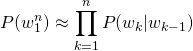
Thus, for a bigram
N-gram
The -gram (which looks  words into the past) approximates the probability as follows

Parameter Estimation
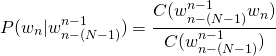
Maximum Likelihood estimation is used to compute the parameters of an -gram model. This process involves getting counts from a corpus, and normalizing the counts so that they lie between  and
and  .
.
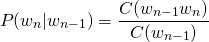
To compute a particular bigram probability of a word  given a previous word
  , compute the count of the bigram
  and normalize by the sum of all the bigrams that share the same first word

The sum of all bigram counts that start with a given word  must be equal to the unigram count for that word .
For the general case of MLE -gram parameter estimation:
Perplexity
The perplexity (sometimes called  for short) of a language model on a test set is the inverse probability of the test set, normalized by the number of words. The higher the conditional probability of the word sequence, the lower the perplexity. Consider the test set
  .
.
![\begin{equation*} PP(W) = P(w_1w_2 \cdots w_N)^{-\frac{1}{N}} = \sqrt[N]{\frac{1}{P(w_1w_2 \cdots w_N)}} = \sqrt[N]{\prod_{i=1}^{N}\frac{1}{P(w_i|w_1 \cdots w_{i-1})}} \end{equation*}](http://thebeardsage.com/wp-content/ql-cache/quicklatex.com-deec9aac0f98b67f2732783f5426b714_l3.png "Rendered by QuickLaTeX.com")
For a bigram language model
![\begin{equation*} PP(W) = \sqrt[N]{\prod_{i=1}^{N}\frac{1}{P(w_i|w_{i-1})}} \end{equation*}](http://thebeardsage.com/wp-content/ql-cache/quicklatex.com-c07bc194ac5bcc8c893143b225efde41_l3.png "Rendered by QuickLaTeX.com")
The more the information the -gram gives about a word sequence, the lower the perplexity.
Smoothing
Smoothing is a technique to prevent a language models from assigning zero probability to unseen events.
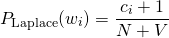
The unsmoothed Maximum Likelihood Estimate of the unigram probability of the word  is its count
  normalized by the total number of word tokens .

Laplace (add-one) Smoothing technique adds a one to all the bigram counts. Since there are  words in the vocabulary and each one was incremented, the denominator needs to be adjusted to take into account the extra observations.
Comparing the two equations above
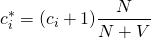
The adjusted count  describes how the smoothing affects the numerator.
The bigram probabilities follow the same technique
![\begin{align*} P_{\text{Laplace}}(w_n|w_{n-1}) &= \frac{C(w_{n-1}w_n) + 1}{\sum_w(C(w_{n-1}w) + 1)} = \frac{C(w_{n-1}w_n) + 1}{C(w_{n-1}) + V} \\ c^*(w_n|w_{n-1}) &= \frac{[C(w_{n-1}w_n) + 1] \cdot C(w_{n-1})}{C(w_{n-1}) + V} \end{align*}](http://thebeardsage.com/wp-content/ql-cache/quicklatex.com-29629b4dc55c9a430c6b090732176cf6_l3.png "Rendered by QuickLaTeX.com")
An extension of the above technique is to add  instead of .

Interpolation
Interpolation is an approach to mix the probability estimates from all the -gram estimators. The trigram, bigram, and unigram counts are weighed and combined. An example of simple linear interpolation is given below

such that
